



Picture two advertisers paying the same cost per click. One converts 2% of visitors, the other 4%. The second pays half as much per customer, can afford to bid higher, wins more auctions, and feeds the ad platform twice as many conversion signals to learn from. Nothing about their ads is different. Their pages are.
Conversion rate optimization (CRO) is the discipline of finding out why visitors do not convert, fixing it, and proving the fix worked. In 2026 it matters even more, because ad platforms increasingly choose your landing page for you (through final URL expansion and AI-generated experiences), and because automated bidding rewards whoever converts best.
This playbook covers research, page anatomy, a testing program and how AI is changing the work.
The short version
- Research before you test. Most failed tests come from guessing. Analytics, session recordings, surveys and sales conversations tell you where the problem is.
- Match the page to the promise. The ad, the query and the page should tell one story. Message match is still the biggest single lever.
- Speed and clarity before cleverness. A fast page that says clearly what you get, why to trust you and what to do next beats a beautiful one that does not.
- Test big things, with enough traffic, and keep a log so you learn, not just win.
Part 1: Research that finds the real problem
Spend more time here than feels comfortable. It is where the wins come from.
Quantitative: where do people drop?
- Funnel reports in GA4 from landing page to conversion, split by device, channel and campaign. Mobile and desktop often have completely different problems.
- Page-level conversion rates for your top landing pages. The worst high-traffic page is usually the best opportunity.
- Form analytics. Which fields cause abandonment? Phone number, budget and “company size” are frequent culprits.
- Speed and Core Web Vitals. Slow pages leak conversions before anyone reads a word, especially from paid social on mobile.
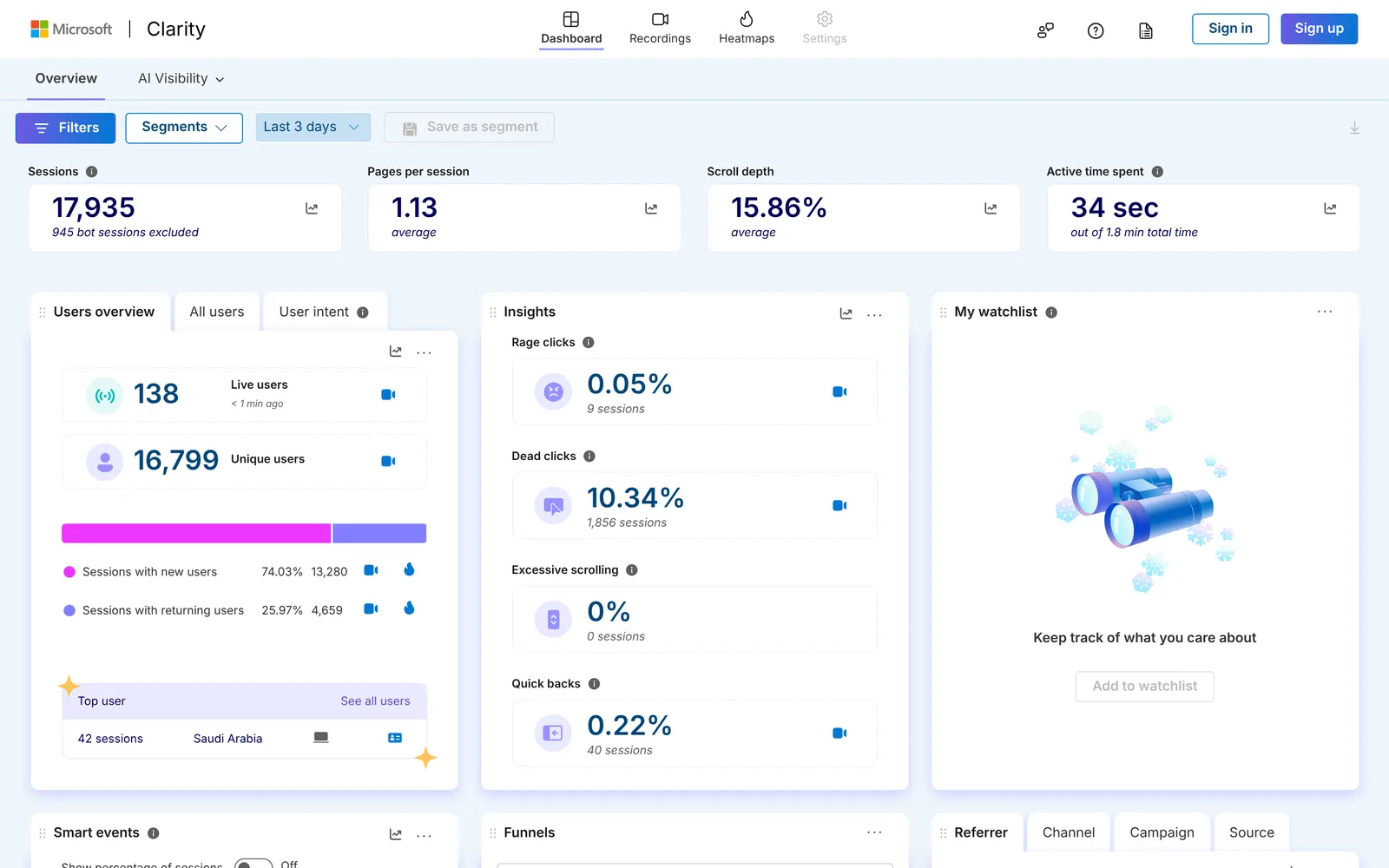
Clarity’s dashboard (public demo) flags behavior worth investigating: dead clicks on things that look clickable, rage clicks, quick backs and shallow scroll depth.
Qualitative: why do they drop?
- Session recordings and heatmaps. A free tool like Microsoft Clarity shows rage clicks, dead clicks and how far people scroll. Watch twenty recordings of people who did not convert and patterns appear quickly.
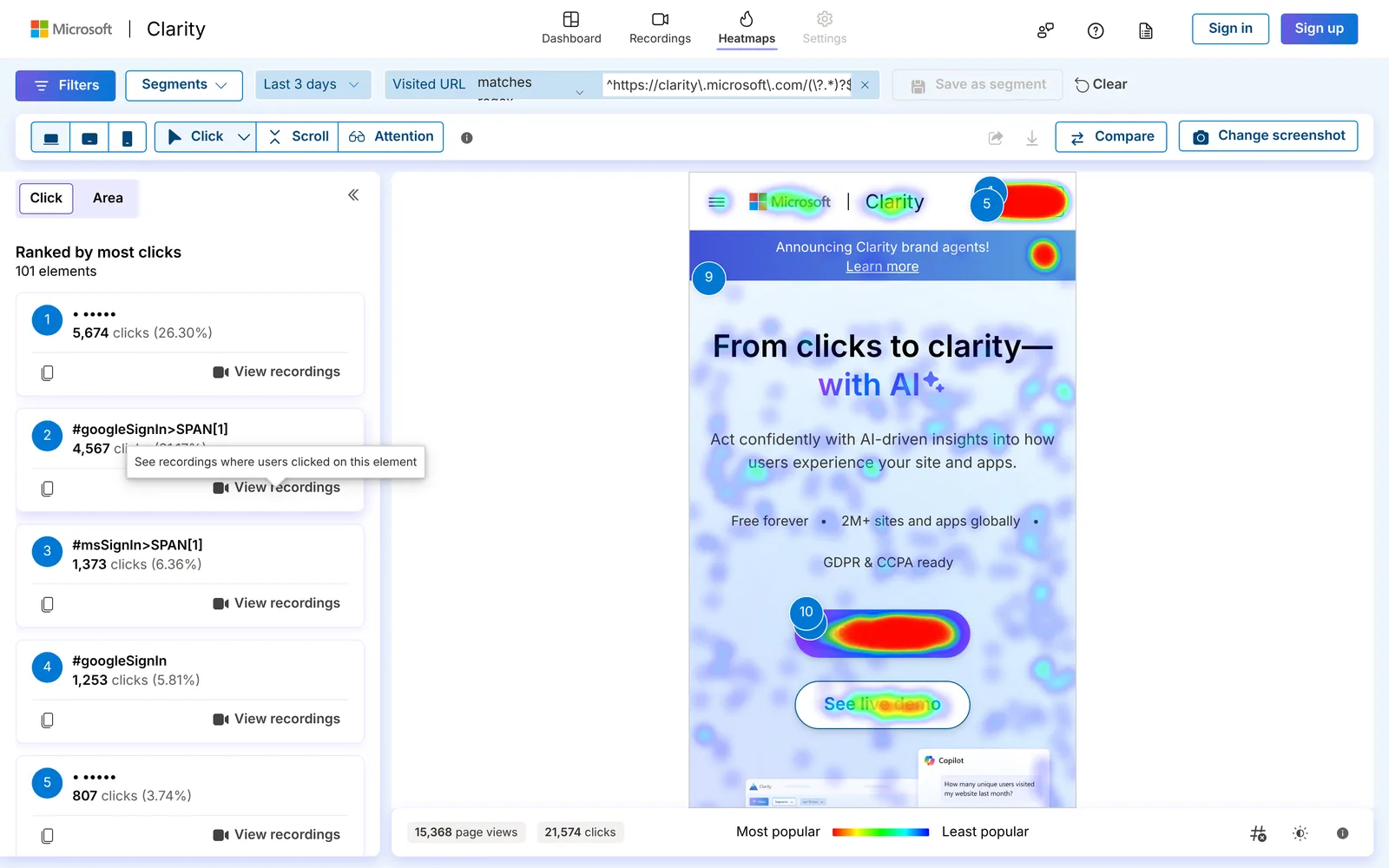
A click heatmap from Microsoft Clarity’s public demo. The hottest areas show where attention goes. Compare them with where you want it to go, then watch recordings of the sessions that clicked somewhere unexpected.
- On-page surveys. One question on exit or after a pause: “What stopped you from booking today?” The answers are often blunt and useful.
- Customer and sales conversations. Ask recent customers why they chose you and what nearly stopped them. Ask the sales team or front desk what prospects ask before they buy.
- Reviews (yours and competitors’). The language customers use is the language your page should use.
Turn the research into a list of problems, each with evidence, before anyone suggests a solution.
Part 2: The anatomy of a landing page that converts
Most converting pages answer the same questions in roughly the same order:
| Section | Question it answers | What good looks like |
|---|---|---|
| Headline | Am I in the right place? | Mirrors the ad and the search query. Says the outcome, not the company slogan |
| Subhead and hero | What exactly do I get? | The offer in one line. A real photo or product view, not stock imagery |
| Primary call to action | What do I do next? | One clear action, visible without scrolling, repeated down the page |
| Proof | Why should I believe you? | Reviews with names, ratings, numbers, logos, before-and-afters, credentials |
| Benefits and details | Will it work for me? | Outcomes first, features second. Specifics over adjectives |
| Objections | What could go wrong? | Price, timing, risk, effort, each answered directly. FAQs work |
| Risk reversal | What if it doesn’t work out? | Guarantees, free consultations, cancellation terms, clear pricing |
| Final call to action | Okay, how do I start? | The same action as the top, with a reason to act now |
Rules worth keeping
- One page, one goal. Remove navigation menus and competing calls to action on paid landing pages.
- Message match is non-negotiable. If the ad says “free whitening consultation”, the headline says “free whitening consultation”, not “Welcome to our clinic”.
- Make forms as short as qualification allows. Every field must earn its place. For high-value leads, multi-step forms often convert better than one long form, because the first step feels easy.
- Design for mobile first. Most paid social and much paid search traffic is on phones: thumb-friendly buttons, readable text, tap-to-call and no pop-ups that block the page.
- Be fast. Compress images, cut unnecessary scripts and watch Core Web Vitals. A one-second improvement on mobile is usually worth more than a new headline.
Part 3: A testing program that produces learning
Prioritize
Score each idea from your research on three things, out of 5:
- Impact: how much could this move conversion if it works?
- Confidence: how strong is the evidence that it is a real problem?
- Effort: how hard is it to build? (Score easy work higher.)
Work from the top. Big, well-evidenced, easy changes first.
Test properly
- Test big changes when traffic is limited. A new offer, layout or page concept can show a difference with modest traffic. Button colors cannot.
- Calculate sample size before you start and do not stop early because one version is “winning” on day three.
- Run for full weeks to cover weekday and weekend behavior, and through at least one buying cycle.
- Measure the real goal. Judge a lead-gen test on qualified leads or bookings, not just form fills.
- Log everything: the hypothesis, what changed, the result and what you learned. A test that loses but explains something is not wasted.
When you cannot A/B test
Many service businesses do not have the traffic for statistically clean tests. That is fine. Use before-and-after comparisons with care (watch seasonality and campaign changes), qualitative research and best-practice fixes. Fixing an obvious problem does not need a test.
Part 4: How AI changes CRO in 2026
- Ad platforms are choosing your pages. Google’s AI Max final URL expansion and Performance Max can send traffic to pages other than the one you picked, and Meta has tested AI-generated landing experiences. Audit every page an ad could land on, use URL rules and exclusions, and check that tracking fires everywhere.
- Personalization is cheaper. AI tools make it practical to create variants by audience, industry, location or campaign. Start with segments that genuinely need different messages (different services, different objections) rather than personalizing for its own sake.
- Research is faster. AI can summarize hundreds of survey answers, reviews or call transcripts into themes in minutes. The judgment about which problem to fix is still yours.
- AI answers pre-qualify visitors. Someone arriving from an AI assistant may already have compared you with competitors. Make your pricing, proof and differentiators easy to find, because they are already deciding.
- Chat and AI agents on the page. Conversational assistants can answer questions and book appointments at any hour. They help when they are fast, accurate and hand off to a human gracefully. They hurt when they block the page or invent answers.
Part 5: Beyond the landing page
Conversion does not end at the form.
- Speed to lead. For service businesses, how fast you respond often matters more than anything on the page. A lead called back in five minutes is far more likely to book than one called the next day. Automate the first response.
- Thank-you pages. Set expectations, offer the next step (book a time, watch a video) and confirm what happens now.
- Show-up rate. For appointments, reminders by email and SMS reduce no-shows. A booked appointment that never happens is a lost conversion.
- Activation. For software, the real conversion is the first moment of value, not the sign-up. See the Activation Strategies.
A 60-day plan
Weeks 1–2: Research
- Rank landing pages by traffic and conversion rate. Pick the top three opportunities.
- Install session recording and heatmaps. Watch at least twenty non-converting sessions per page.
- Run a one-question exit survey and interview five recent customers.
Weeks 3–4: Fix the obvious
- Fix speed issues, broken elements, mobile layout problems and message mismatch.
- Shorten forms and add proof near the call to action.
Weeks 5–8: Test
- Build an impact, confidence and effort backlog from the research.
- Launch the first one or two big tests with proper sample sizes.
- Start a test log and share results monthly with the paid media team.
Common mistakes
- Testing button colors while the offer is the problem.
- Sending all paid traffic to the homepage.
- Calling tests early on small samples.
- Optimizing for form fills when the business needs qualified leads.
- Forgetting the pages AI picks when final URL expansion is turned on.
The bottom line
CRO is the cheapest growth most companies are not doing. Do the research, build pages that match the promise and answer the real objections, test the big things properly and keep learning. Every improvement makes every channel cheaper, and makes the ad platforms’ automation work in your favor.
Last reviewed November 16, 2026.
Sources and further reading
- Microsoft Clarity — Microsoft, accessed November 2026
- Core Web Vitals — web.dev, accessed November 2026
- About Performance Max campaigns — Google Ads Help, accessed November 2026
- Optimizing your website for generative AI features on Google Search — Google Search Central, 2026-07-10