



Every few months a new acronym arrives to describe the same anxiety. AIO, AEO, GEO, LLMO, and now AIEO, which is the one I will use here: AI engine optimization, meaning everything you do so that AI-driven search experiences find, trust, cite and recommend your brand.
The anxiety is real. Answers now sit above, or instead of, the ten blue links. Buyers ask ChatGPT to shortlist vendors before they ever see your homepage. And a growing share of research happens inside a chat window where you cannot buy a keyword the old way, cannot see the query, and cannot always see the click.
But the industry around that anxiety has run ahead of the evidence. So this playbook starts with what the platforms themselves have published in 2026, separates it from what vendors are selling, and then lays out the plan I would run.
The short version
- Google’s position is official and plain: to appear in AI Overviews and AI Mode, a page has to be indexed and eligible to show with a snippet. Beyond that, the same fundamentals apply. No special files, no special markup, no rewriting “for AI”.
- The work that moves AI visibility is the work that always moved search: crawlable pages, clear structure, first-hand content nobody else can produce, accurate business and product data, and a brand people talk about.
- ChatGPT is now a channel with its own surfaces: a business profile you can claim, an ads platform you can buy, and an agentic checkout layer that can complete purchases.
- Measurement is the real gap. Search Console now reports generative AI performance for Google. Everything else needs a deliberate measurement plan, or you will be guessing.
What changed in 2026
Google wrote the rulebook down
In May 2026 Google Search Central published a dedicated guide, Optimizing your website for generative AI features on Google Search, and has updated it since. The headline is that optimizing for AI Overviews and AI Mode is not a separate discipline. Search Engine Journal summed up the guide as Google calling AEO and GEO “still SEO”.
The useful detail is in what Google says you don’t need:
- No
llms.txtfile or other AI-specific files. - No special schema.org markup to qualify for AI features. Structured data still matters for rich results, but there is no secret AI schema.
- No “chunking” content into fragments, and no rewriting pages in a special style for AI.
And what it says you do need:
- Pages that are indexed and eligible to appear with a snippet.
- The usual technical basics: crawlable pages, a clear structure, good page experience and less duplicate content.
- Content that is not a commodity: first-hand experience, original data and real expertise.
- For products and local businesses, accurate data where Google already reads it, such as Merchant Center feeds and Business Profiles.
There is also a warning worth taking seriously. AI Mode answers a question by running many related searches behind the scenes (“query fan-out”). Some teams responded by mass-producing thin pages to match every possible sub-question. Google’s guide treats that as scaled content abuse. If your AI search plan involves generating hundreds of near-identical pages, stop.
Google added measurement
Search Console introduced generative AI performance reporting in June 2026. That gives you Google’s own view of how people find your content through AI features, instead of relying only on third-party tools. Google is also clear that outside tools cannot see inside its ranking or AI systems. They can sample answers, but they are estimating.
Ads moved inside the answer
Google now shows ads in AI Overviews and AI Mode, so the paid and organic sides of AI search are no longer separate conversations. On the OpenAI side, ChatGPT ads started as a CPM pilot, added CPC buying in May 2026 (you pay only for clicks), and began rolling out a self-serve Ads Manager in beta. OpenAI also launched a Conversions API and pixel for measurement, and says ads stay clearly separated from answers, which remain independent. I cover the bidding side in the Paid Search Strategy.
ChatGPT gave businesses a front door
On November 10, 2026 OpenAI launched Businesses in ChatGPT in beta. Through a Business Hub, a company can claim its profile, verify that the person claiming is authorized, and keep its details accurate. Claiming is free and available wherever ChatGPT is available. Visibility insights appear once interactions pass a privacy threshold, and OpenAI says it does not share users’ conversations with businesses. Business Agents, which let a brand run its own conversational agent inside ChatGPT, are limited at launch to eligible US e-commerce and online service businesses.
Agents started to buy
Since late 2025 ChatGPT has supported Instant Checkout, built on the open Agentic Commerce Protocol, so a user can buy from a merchant without leaving the chat. Google’s guide now points to agent-friendly site practices and its Universal Commerce Protocol for agents in Search. Agentic commerce is early, but it changes a basic assumption: the “visitor” on your checkout page might not be a person.
How AI search actually picks sources
You do not need the internals to plan well, but you do need the right mental model.
- Retrieval first. Google’s AI features are built on Google Search’s index. If a page is not indexed or not eligible for a snippet, it is not a candidate. ChatGPT search similarly retrieves live web results before it writes an answer. Crawlability and indexing are the entry ticket, not a nice-to-have.
- Fan-out widens the net. One user question becomes many background searches. That rewards sites that cover a topic thoroughly and clearly, not sites with one page per keyword.
- Synthesis favors clarity and evidence. When a model writes an answer from several sources, it leans on passages that state a fact plainly, back it up, and make sense on their own. That is just good writing, which is why Google says you do not need to write “for AI”.
- Entity confidence matters. Models are more comfortable recommending a brand that is consistently described across the web: your site, your Business Profile, review sites, directories, press and community discussion. Inconsistent names, addresses, prices or claims make you a riskier citation.
The playbook
1. Make sure you are eligible
This is unglamorous and it is where most of the wins are.
- Check that key pages are indexed in Search Console and are not blocked by
robots.txt,noindexor canonical mistakes. - Do not block snippets on pages you want cited.
nosnippetand very shortmax-snippetvalues limit what Google can show. - Decide deliberately which AI crawlers you allow. Blocking OpenAI’s search crawler keeps you out of ChatGPT search results. Blocking training crawlers is a separate choice. Make both decisions on purpose rather than inheriting a default from your CDN or security plugin.
- Fix duplicate content and thin templated pages. Fan-out rewards one strong page per topic over ten weak ones.
- Make sure your CDN or bot protection is not silently blocking legitimate crawlers and agents. This is now one of the most common hidden causes of AI invisibility.
2. Build pages worth citing
Write the page that answers the question better than anyone else can, then make it easy to quote.
- Lead with the answer. Put the direct answer in the first paragraph, then the nuance. Models and people both skim.
- Add what only you know. Original numbers, worked examples, screenshots, prices, timelines, before-and-after results, and honest trade-offs. Google’s word for the opposite is “commodity” content, and commodity content has nothing to cite.
- Use clean structure. Descriptive headings, short paragraphs, real HTML lists and tables. This is semantic HTML, not special AI formatting.
- Show who wrote it and why they are credible. Named authors, real bios and dated updates help readers decide whether to trust a page, and they make a source easier to recommend.
- Keep facts current. Date your updates. Out-of-date pricing or specs are exactly the claims an AI answer will get wrong, and the kind of thing that makes a model stop citing you.
3. Make your business data unambiguous
For local, service and product businesses, much of AI visibility comes from structured business data rather than from blog posts.
- Google Business Profile: complete categories, services, hours, attributes, photos and steady review flow. This feeds local answers in AI Mode.
- Merchant Center: clean product feeds with accurate price, availability, shipping and return policies. This feeds shopping answers.
- Businesses in ChatGPT: claim and verify your profile in the Business Hub, then keep it as accurate as your Google profile. It costs nothing, and it is the closest thing ChatGPT has to a Business Profile.
- Consistency everywhere else: your name, address, phone, pricing model and core claims should match across your site, directories, review platforms and social profiles.
4. Earn the mentions that models trust
Links still matter, but in AI search, mentions and descriptions matter too. A model forms a view of your brand from what others say about it.
- Get reviewed and listed where your buyers research: industry directories, comparison sites, marketplaces and review platforms.
- Publish original research, benchmarks or data that others will quote. Being the source of a statistic is one of the most durable forms of visibility.
- Show up in community conversations (Reddit, industry Slack groups, LinkedIn and YouTube) with genuinely useful answers, not drive-by links.
- Pitch expert commentary to journalists and newsletters in your niche. Earned media is cited far more often than brand-owned copy.
5. Get ready for agents
Agentic commerce is early, so treat this as preparation, not a rebuild.
- Make product, pricing and availability data machine-readable and accurate: feeds, structured data and clean HTML.
- Keep checkout fast and simple, with guest checkout and clear errors. Anything that confuses a person confuses an agent more.
- Review bot and firewall rules so verified agents are not blocked by default.
- If you sell on Shopify or another supported platform, review the agentic checkout options the platform offers and decide whether to opt in.
6. Decide your paid stance
AI answers now carry ads on both Google and ChatGPT. You do not need to rush in, but you should decide on purpose.
- On Google, AI Overviews and AI Mode inventory is reached through existing campaign types rather than a separate buy. Your broad match, Performance Max and AI Max settings decide whether you show up there.
- On ChatGPT, start small with CPC buying, clear conversion tracking through the Conversions API or pixel, and a tight test budget. Treat early results as directional.
- Plan organic and paid together. If you pay for a placement next to an answer that already cites you, you may be buying clicks you would have earned anyway. An incrementality test answers that.
How to measure AI visibility
This is the part most AI search plans skip, and it is why so many of them cannot prove anything.
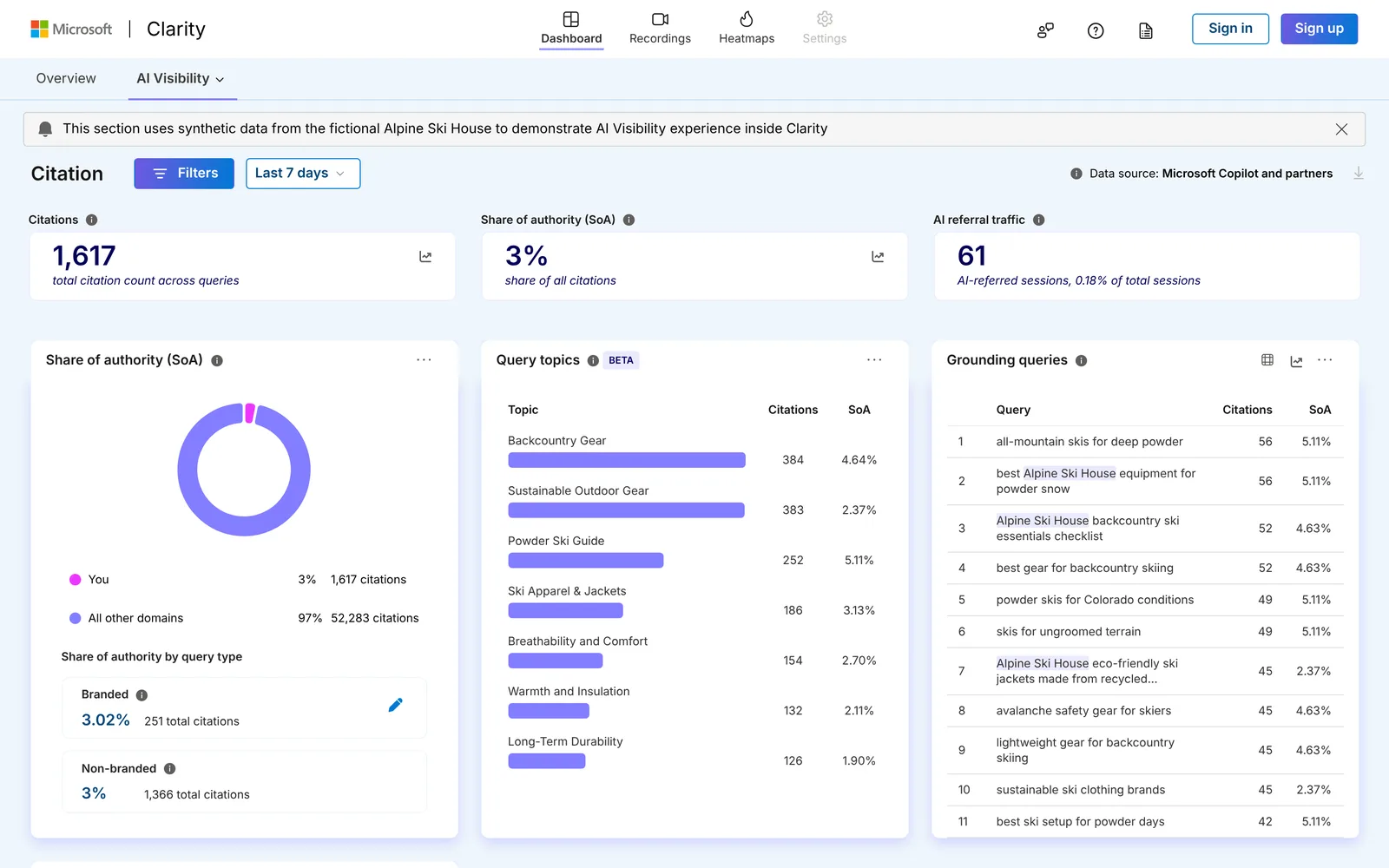
Microsoft Clarity’s public demo (fictional brand “Alpine Ski House”): its AI Visibility view tracks how often AI answers cite a site, its share of all citations, the queries behind them and AI-referred sessions. It is one of the few free tools showing this for Microsoft Copilot and partners.
| What to track | Where | Why it matters |
|---|---|---|
| Generative AI performance | Search Console | Google’s own data on how people reach you through AI features |
| Referral sessions from AI assistants | GA4, filtered by source (chatgpt.com, perplexity.ai, gemini.google.com, copilot.microsoft.com) | Clicks you can attribute directly |
| Visibility insights | ChatGPT Business Hub | OpenAI’s view of how people interact with your profile, once it passes the privacy threshold |
| Prompt-level share of voice | A fixed prompt set, checked monthly by hand or with a tracking tool | Whether you are mentioned, how you are described, and who appears instead |
| Branded search and direct traffic | Search Console and GA4 | AI answers often create demand that converts later through a branded search |
| Assisted conversions | GA4 and CRM, with “How did you hear about us?” on forms | Captures influence the click data misses |
Two rules make this work. First, build your prompt set from real customer questions (sales calls, support tickets, on-site search) rather than from your keyword list. Second, track the same prompts on the same schedule so you are comparing like with like. AI answers vary from run to run, so look at trends over weeks, not single screenshots.
A 90-day plan
Days 1–30: Foundations
- Audit indexing, snippet controls, canonicals and duplicate content on your top 50 pages.
- Review
robots.txtand CDN or bot rules for search crawlers, AI crawlers and agents. - Claim and verify your profile in ChatGPT’s Business Hub. Clean up your Google Business Profile and Merchant Center.
- Set up GA4 channel grouping for AI referrers and add “How did you hear about us?” to lead forms.
- Write your 30 to 50 prompt tracking set and record a baseline.
Days 31–60: Content and authority
- Rewrite your ten most commercially important pages to lead with the answer, add first-hand evidence and show clear authorship.
- Publish one piece of original data or research your market will want to quote.
- Fix inconsistent business details across directories and review sites.
- Start a steady review program for your Business Profile and main review platforms.
Days 61–90: Scale and test
- Expand topic coverage where fan-out exposes gaps, with one strong page per real question cluster.
- Run a small, tracked ChatGPT ads test if your category has buying intent there.
- Review the prompt set: where are you mentioned, how are you described, and who is recommended instead? Turn the gaps into next quarter’s content plan.
Common mistakes
- Buying an “AI optimization” package built on
llms.txtand special markup. Google has said plainly that it does not need them. - Mass-producing fan-out pages. Google treats this as scaled content abuse, and it dilutes the strong pages you already have.
- Blocking crawlers by accident. A security setting can quietly remove you from AI answers.
- Treating one screenshot as a result. Answers vary between runs. Measure trends across a fixed prompt set.
- Ignoring the offline signal. Some of the impact shows up as branded search, direct traffic and “ChatGPT recommended you” on a sales call. Ask, and record it.
The bottom line
The brands that win in AI search are not the ones gaming a new algorithm. They are the ones that are easy to find, easy to understand and easy to trust: indexed pages, clear first-hand content, consistent business data, a real reputation, and a measurement plan that tracks influence as well as clicks. That was good marketing before AI search. It is now the price of being recommended.
Last reviewed November 16, 2026. AI search products change monthly. I update this playbook when the platforms change their guidance.
Sources and further reading
- Optimizing your website for generative AI features on Google Search — Google Search Central, 2026-07-10
- A new resource for optimizing for generative AI in Google Search — Google Search Central Blog, 2026-05
- Google's new AI search guide calls AEO and GEO "still SEO" — Search Engine Journal, 2026-05-15
- Introducing Businesses in ChatGPT — OpenAI, 2026-11-10
- OpenAI just made it free to claim your business a profile in ChatGPT — Dynamic Business, 2026-11-13
- New ways to buy ChatGPT ads — OpenAI, 2026-05-05
- Buy it in ChatGPT (Instant Checkout and the Agentic Commerce Protocol) — OpenAI, 2025-09-29